
About the Journal

Western Journal of Medical and Biomedical Sciences (WJMBS) is the official journal of University of Medical Sciences, Faculty of Basic Clinical Sciences, Ondo-city, Ondo State Nigeria.

WJMBS is a quarterly double-blind, peer-reviewed, online and print institutional journal. The journal invites high quality or cutting-edge research works from all fields of medical and biomedical sciences for publication consideration.

The journal publishes quarterly in March, June, September, and December. The editorial board ensures that accepted articles are published within three months from the date of initial manuscript submission.

Current Issue

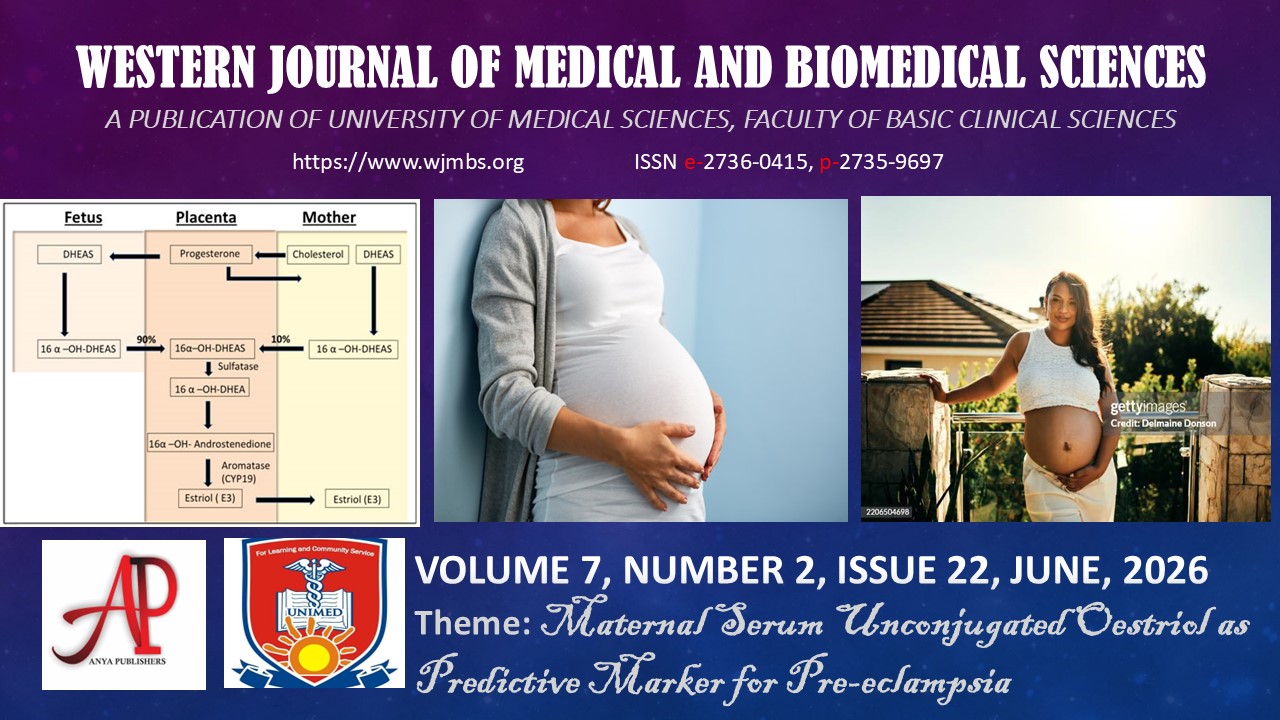
Vol. 7 No. 2 (2026): Maternal Serum Unconjugated Oestriol as Predictive Marker for Pre-eclampsia
					View Vol. 7 No. 2 (2026): Maternal Serum Unconjugated Oestriol as Predictive Marker for Pre-eclampsia

Foreword
This 22nd issue of the Western Journal of Medical and Biomedical Sciences comes with the title: “Maternal Serum Unconjugated Oestriol as Predictive Marker for Pre-eclampsia” wherein the authors critically looked at the role of maternal serum unconjugated oestriol (uE3) as a predictive marker for pre-eclampsia and poor clinical neonatal outcome in Sokoto. They found that maternal serum levels of uE3 for preeclamptic women were significantly lower compared to the controls. Mothers with poor clinical neonatal babies, had lower uE3 than mothers with normal babies. They then concluded that, at cut-off value of ≤ 25.50 ng/ml for uE3, the predictive power for developing pre-eclampsia was excellent, and at cut-off value of ≤ 16.50 ng/ml for uE3, the predictive power for developing poor neonatal outcomes was good. And hence eventually recommended that maternal serum uE3 levels at the second trimester and above may be useful in predicting preeclampsia and poor clinical neonatal outcomes.
In another study, researchers looked at the effectiveness of a physician-led primary prevention programme in reducing cardiovascular risks among vulnerable workers. This is in the midst of the increasing incidences of heart and associated vascular diseases globally including Nigeria. They found that, although changes in overall CVD risk were not statistically significant, the physician-led intervention however effectively improved major modifiable risk factors, supporting its
potential for scalable workplace CVD prevention in Nigeria.
Abdominal surgeries often go with it several complications especially in the tropical and sub-tropical regions of the world where qualitative healthcare facilities are in short supply. A team of researchers in Benin-city assessed the determinants of pulmonary morbidities following elective abdominal surgery at the University of Benin Teaching Hospital. And they found that, pulmonary complications were more frequent in patients older than 60 years (69.6%) and in those with pre operative shortness of breath (88.9%). Significant predictors were found to include smoking (p = 0.014), low serum albumin (p = 0.021), COPD (p =  0.025), use of long-acting muscle relaxants (p = 0.048), prolonged surgery > 2 hours (p < 0.001) and elevated pre-operative respiratory rate (p = 0.010). ASA Class III patients had the highest complication rate (73.1%). Postoperative pulmonary complications arise from both modifiable and non-modifiable factors. They therefore recommended focusing on the modifiable factors that offer the greatest potential to reduce the burden of POPCs and improve surgical outcomes, especially in resource-limited settings.
The eye as we know is the window through which we see the world, and proper management of eye diseases ensures a good eye sight to productively engage the world. Here a team of researchers presented a case of bilateral rhegmatogenous retinal detachment (RRD) following sequential cataract surgeries performed at different centers, including a community outreach setting. This is a classical case of a poorly managed preventable cause of blindness but nevertheless leading to irreversible  blindness; a scenario reminiscent at high frequency in the developing world. They therefore advised that cataract surgery in outreach settings along with several other sensitive surgeries performed under such gross infrastructural and logistic deficits, if must be done, must adhere to strict clinical protocols, including proper patient selection, risk assessment, and structured follow-up systems to prevent avoidable blindness.
Professor Michael Simidele Odimayo
Editor-In-Chief
30th June, 2026

Published: 2026-06-30

Articles

View All Issues
WJ
WJMBS
Western Journal of Medical & Biomedical Sciences
 
AP
Anya Publishers
Publishing Excellence

WJMBS by the Numbers

2019
Year Founded
4
Issues per Year
35+
Countries Reached
4.7
Impact Factor

About the Journal

WJMBS is the official journal of the University of Medical Sciences, Faculty of Basic Clinical Sciences, Ondo-city, Ondo State, Nigeria.

A quarterly, double-blind, peer-reviewed, open access journal publishing high-quality research in medical and biomedical sciences.

???? ISSN: 2736-0415 ???? Impact Factor: 4.7 ???? Open Access

Why Choose Us

  • Double-blind peer review
  • Fast publication within 3 months
  • No submission fees
  • Indexed in Google Scholar & Crossref
  • Affordable APC (₦40,000 / $115)

© 2024 Western Journal of Medical and Biomedical Sciences (WJMBS). All rights reserved.

Published in collaboration with Anya Publishers | University of Medical Sciences, Faculty of Basic Clinical Sciences, Ondo-City, Nigeria