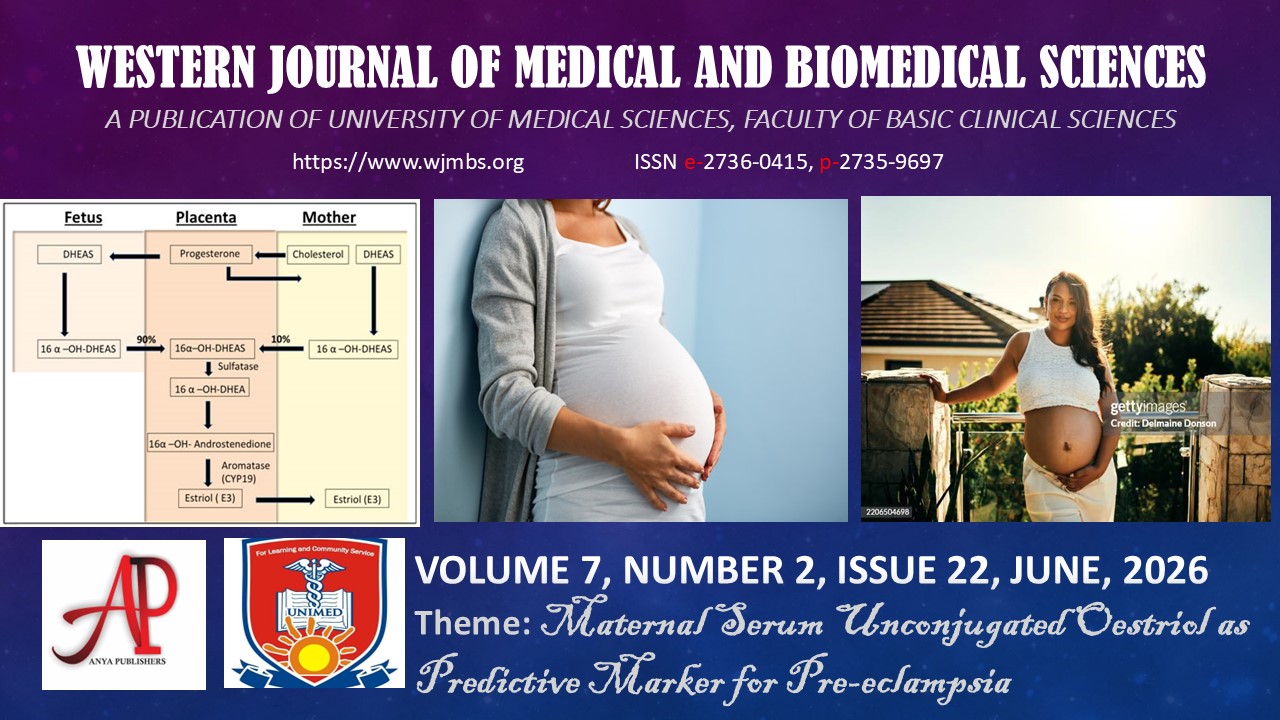
Role of Maternal Serum Unconjugated Oestriol as Predictive Marker for Pre-eclampsiaand Poor Clinical Neonatal Outcome in Sokoto, North-West Nigeria
Keywords:
Maternal, Preeclampsia, Serum, Sokoto, uE3Abstract
Preeclampsia and its related maternal and neonatal complications remain a significant global public health threat and economic concern, especially in developing countries. It contributes to the high maternal and neonatal morbidity and mortality in Sokoto. Some of the analytes evaluated had low predictive power for preeclampsia and poor neonatal outcomes in Sokoto. The present study assessed the role of maternal serum unconjugated oestriol (uE3) as a predictive marker for pre-eclampsia and poor clinical neonatal outcome in Sokoto. It was prospective case-control study conducted in some selected hospitals in the Sokoto metropolis. Two hundred participants were recruited for this study. The data obtained were analysed using SPSS 25 version statistical software. Variables were compared using an unpaired Student t- test analysis, and the predictive value for developing preeclampsia and poor clinical neonatal outcome was determined using a Receiver Operating Characteristic analysis. The results showed that maternal serum levels of uE3 for preeclamptic women were significantly lower compared to the controls (11.340.58, 32.051.04a ng/ml, p=0.000). Mothers with poor clinical neonatal babies, had lower uE3 than mothers with normal babies. A cut-off value of ≤ 25.5 ng/ml for uE3, the predictive power for developing pre-eclampsia was excellent, and at cut-off value of ≤ 16.50 ng/ml for uE3, the predictive power for developing poor neonatal outcomes was good. In conclusion, maternal serum uE3 levels at the second trimester and above may be useful in predicting preeclampsia and poor clinical neonatal outcomes.
References
1. Aziz A, Salam U. A. Maternal and Perinatal Outcomes of Early and Late Onset Preeclampsia with Severe Features in Secondary Health Care. Journal Kedokteran Diponegoro (Diponegoro Medical Journal), 2025; 14(1).
2. Celiz E. C, Julcamoro, M. M. V, Hilario S. D. V. Preeclampsia: Major Complications and the Role of Nursing in Reducing Maternal Mortality. SCT Proceedings in Interdisciplinary Insights and Innovations. 2025; 3(4).
3. Tecleab A, Lyashchenko A. K, Rai, A. J. Quad Screen Test, A Multiplexed Biomarker Assay for Prenatal Screening to Assess Birth Defects: The Columbia University Experience Using the Beckman Access2 Immunoassay Analyzer and Benetech PRA Prenatal Diagnosis 2019, pp. 297-307: Springer.
4. Merkatz I. R, Nitowsky H. M, Macri J. N, Johnson W. E. An association between low maternal serum α-foetoprotein and foetal chromosomal abnormalities. American journal of obstetrics and gynecology, 1984,148(7), 886-894.
5. Yuan X, Long W, Liu J, Zhang B, Zhou W, Jiang J, Wang H. Associations of serum markers screening for Down's syndrome with pregnancy outcomes: A Chinese retrospective cohort study. Clinica Chimica Acta. 2019; 489: 130-135.
6. Jelin A. C, Sagaser K. G, Wilkins-Haug L. Prenatal Genetic Testing Options. Pediatric Clinics. 2019;66(2): 281-293.
7. Mehmood A, Noor N, Shah Z, Irfan M. Physiological changes in 50 women during pregnancy. KJMS. 2018; 11(1): 47.
8. Hauspurg A, Parry S, Mercer B. M, Grobman W, Hatfield T, Silver R. M, et al. Blood pressure trajectory and category and risk of hypertensive disorders of pregnancy in nulliparous women. American Journal of Obstetrics & Gynaecology, 2019, 45(2), 34-39.
9. Lemoine E, Thadhani, R. Affordable Preeclampsia Therapeutics. Trends in pharmacological sciences. 2019; 40(2): 85-87.
10. Lisonkova S, Joseph K. Incidence of Preeclampsia: risk factors and outcomes associated with early-versus late-onset disease. American journal of obstetrics and gynecology. 2013; 209(6): 544. e541-544. e512.
11. Lisonkova S, Sabr Y, Mayer C, Young C, Skoll A, Joseph K. Maternal morbidity associated with early-onset and late-onset Preeclampsia. Obstetrics & Gynecology. 2014; 124(4): 771-781.
12. Tunau K, Sulaiman R, Garba J, Aliyu F, Panti A, Hassan, M. Presentation and outcome of Preeclampsia: A five-year review in Uduth, Sokoto. Caliphate Med Journal. 2018; 6: 1-4.
13. Falah N, Torday J, Quinney S. K, Haas D. M. Estriol review: Clinical applications and potential biomedical importance. Clin Res. 2015; 1(2): 29-33.
14. De Hertogh R, Thomas K, Bietlot Y, Vanderheyden I, Ferin J. Plasma levels of unconjugated estrone, estradiol, estriol, and HCS throughout pregnancy in normal women. The Journal of Clinical Endocrinology & Metabolism. 1975; 40(1): 93-101.
15. Yeast J. D, Lu G. Biochemical markers for the prediction of preterm delivery. Clinics in perinatology. 2007; 34(4): 573-586.
16. Parisi F, Fenizia C, Introini A, Zavatta A, Scaccabarozzi C, Biasin M, et al. The pathophysiological role of estrogens in the initial stages of pregnancy: molecular mechanisms and clinical implications for pregnancy outcome from the periconceptional period to end of the first trimester. Human reproduction update. 2023 Nov 1;29(6):699-720.
17. Settiyanan T, Wanapirak C, Sirichotiyakul S, Tongprasert F, Srisupundit K, Luewan S, et al. Association between isolated abnormal levels of maternal serum unconjugated estriol in the second trimester and adverse pregnancy outcomes. The Journal of Maternal-Foetal & Neonatal Medicine. 2016; 29(13): 2093-2097.
18. Dugoff L, Hobbins J. C, Malone F. D, Vidaver J, Sullivan L, Canick J. A, et al. Quad screen as a predictor of adverse pregnancy outcome. Obstetrics & Gynecology. 2005; 106(2): 260-267.
19. Briceño-Pérez C, Briceño-Sanabria L, Vigil-De Gracia, P. Prediction and prevention of Preeclampsia. Hypertension in pregnancy. 2009; 28(2): 138-155.
20. Karakış LS, Turkgeldi E, Kiyak H, Yücel N. Abnormal first and second trimester maternal serum marker levels for aneuploidy screening and adverse pregnancy outcomes. Eastern Journal of Medicine. 2021 Jul 1;26(3):418-25. ;29(6):699-720.
21. Jan S, Bhat B. A. Teenage Pregnancy and Health Implications. In Social, Political, and Health Implications of Early Marriage 2025, pp. 327-340). IGI Global Scientific Publishing.
22. Vijay C, Sreenivas S. Teenage Pregnancies and Its Perinatal Outcomes in a Tertiary Care Center: A Retrospective Study. International Journal of Infertility & Fetal Medicine. 2025; 15(3): 141-144.
23. Singh S, Ahmed E. B, Egondu S. C, Ikechukwu N. E. Hypertensive disorders in pregnancy among pregnant women in a Nigerian Teaching Hospital. Nigerian medical journal. 2014; 55(5): 384.
24. Abubakar R, Yohanna S, Zubairu H. Cultural perceptions influencing obstetric complications among women in Kaduna, Northwestern Nigeria. Nigerian journal of clinical practice. 2018; 21(7): 832-839.
25. Amna A. Late antenatal booking, its barriers, and maternal complications. Israel Medical Journal. 2025; 25(2):35.
26. Nnamani C. P, Onwusulu D. N, Offor C. C, Ekwebene, O. C. Timing and associated factors of antenatal booking among pregnant women at a tertiary health institution in Nigeria: A cross-sectional study. J Clin Images Med Case Rep. 2022; 3(2): 1646.
27. Aliyu MH, Luke S, Kristensen S, Alio AP, Salihu HM. The joint effect of obesity and teenage pregnancy on the risk of Preeclampsia: a population-based study. Journal of Adolescent Health. 2010; 46(1): 77-82.
28. Bartsch E, Medcalf KE, Park AL, Ray JG. Clinical risk factors for preeclampsia determined in early pregnancy: systematic review and meta-analysis of large cohort studies. bmj, 2016; 353: i1753.
29. Kahveci B, Melekoglu R, Evruke I. C, Cetin, C. The effect of advanced maternal age on perinatal outcomes in nulliparous singleton pregnancies. BMC pregnancy and childbirth. 2018; 18(1): 1-7.
30. Demissie M, Molla G, Tayachew A, Getachew F. Risk factors of Preeclampsia among pregnant women admitted at labour ward of public hospitals, low-income country of Ethiopia; a case-control study. Pregnancy Hypertension. 2022; 27; 36-41.
31. Woelkers D, Barton J, von Dadelszen P, Sibai B. The revised 2013 ACOG definitions of hypertensive disorders of pregnancy significantly increase the diagnostic prevalence of Preeclampsia. Pregnancy Hypertension: An International Journal of Women's Cardiovascular Health. 2015; 5(1): 38.
32. Daniel C, Singh S. Cesarean delivery: An experience from a tertiary institution in northwestern Nigeria. Nigerian journal of clinical practice. 2016; 19(1): 18-24.
33. Ugwa E, Ashimi A, Abubakar M. Y. Cesarean section and perinatal outcomes in a sub-urban tertiary hospital in North-West Nigeria. Nigerian medical journal: journal of the Nigeria Medical Association. 2025; 56(3): 180.
34. Jain M, Patel A. A cross-sectional study of rate, indications, and complications of primary cesarean section. International Journal of Reproduction, Contraception, Obstetrics and Gynecology. 2016; 5 (6):1814-1820
35. Yue C.Y, Zhang C.Y, Ying C.M. Serum markers in quadruple screening associated with adverse pregnancy outcomes: A case case–control in China. Clinica Chimica Acta. 2020; 511:278-281.
36. Gu W, Lin J, Hou Y. The value of maternal first and second-trimester serum data of β-hCG, PAPP-A, AFP, and uE3 in the prediction of preeclampsia. Zhonghua fu chan ke za zhi. 2015; 50(2):101-107.
37. Izuka E. O, Obiora-Izuka C. E, Asimadu, E. E, Enebe J. T, Onyeabochukwu A. D, Nwagha, U. I.Effect of Late Antenatal Booking on Maternal Anemia and Fetus Birth Weight on Parturients in Enugu, Nigeria: An Analytical Cross Sectional Study. Nigerian Journal of Clinical Practice. 2023; 26(5): 558-565.
38. Sibanda S, Khozah M. Y, Moyo P. L. Determinants of Late Antenatal Care Bookings Among Pregnant Women in Mangwe District, Zimbabwe: A Quantitative Cross-Sectional Study. Sage Open Medicine, 2026; 14: 20503121261430430.
39. Dickey MS, Goynes KO, Kracht CL, Jones B, Simeon E, Butler J, et al. (A mixed-methods investigation of race, income, food insecurity and maternal and infant health. Public Health Nutrition, 2026;29(1): e36.
40. Settiyanan T, Wanapirak C, Sirichotiyakul S, Tongprasert F, Srisupundit K, Luewan S, et al. Association between isolated abnormal levels of maternal serum unconjugated estriol in the second trimester and adverse pregnancy outcomes. The Journal of Maternal-Fetal & Neonatal Medicine. 2016 Jul 2;29 (13):2093-7.
41. Benn PA, Craffey A, Horne D, Ramsdell L, Rodis JF. Elevated maternal serum alpha‐fetoprotein with low unconjugated estriol and the risk for lethal perinatal outcome. The Journal of Maternal‐Fetal Medicine. 2000 May;9(3):165-9.
42. Dai X, Zhang H, Wu B, Yue C. Correlation between elevated maternal serum alpha-fetoprotein, low uncojugated estriol and ischemic placental disease: a retrospective cohort study. Clinical and Experimental Hypertension. 2023; 45(1): 2175 - 848.
43. Kim MJ, Kim HM, Cha HH, Kim JI, Seong WJ. Correlation between serum markers in the second trimester and preterm birth before 34 weeks in asymptomatic twin pregnancies. International Journal of Gynecology & Obstetrics. 2022 Feb;156(2):355-60.
44. Peris M, Crompton K, Shepherd DA, Amor DJ. The association between human chorionic gonadotropin and adverse pregnancy outcomes: a systematic review and meta-analysis. American Journal of Obstetrics and Gynecology. 2024 Feb 1;230(2):118-84.
45. Yue C.Y, Zhang C.Y, Ying C.M. Serum markers in quadruple screening associated with adverse pregnancy outcomes: A case case–control in China. Clinica Chimica Acta, 2020;511: 278-281.
46. Duric K, Skrablin S, Lesin J, Kalafatic D, Kuvacic I, Suchanek E. Second trimester total human chorionic gonadotropin, alpha-fetoprotein and unconjugated estriol in predicting pregnancy complications other than fetal aneuploidy. European Journal of Obstetrics & Gynecology and Reproductive Biology. 2003 Sep 10;110(1):12-15
47. Wyness SP, Snow TM, Villanueva M, Kunzler T, Seiter J, Genzen JR, Johnson LM. Impact of unconjugated estriol (uE3) assay interference on prenatal screening tests. Clinica Chimica Acta. 2022 Nov 1;536:1-5.
48. Sirikunalai P, Wanapirak C, Sirichotiyakul S, Tongprasert F, Srisupundit K, Luewan S, et al. Associations between maternal serum free beta human chorionic gonadotropin (β-hCG), uE3 levels and adverse pregnancy outcomes. Journal of Obstetrics and Gynaecology. 2016 Feb 17;36(2):178-82.
49. Kim SY, Kim SK, Lee JS, Kim IK, Lee K. The prediction of adverse pregnancy outcome using low unconjugated estriol in the second trimester of pregnancy without risk of Down's syndrome. Yonsei medical journal. 2000 Apr 1;41(2):226-229.
50. Karakış LS, Turkgeldi E, Kiyak H, Yücel N. Abnormal first and second trimester maternal serum marker levels for aneuploidy screening and adverse pregnancy outcomes. Eastern Journal of Medicine. 2021 Jul 1;26(3):418-25.