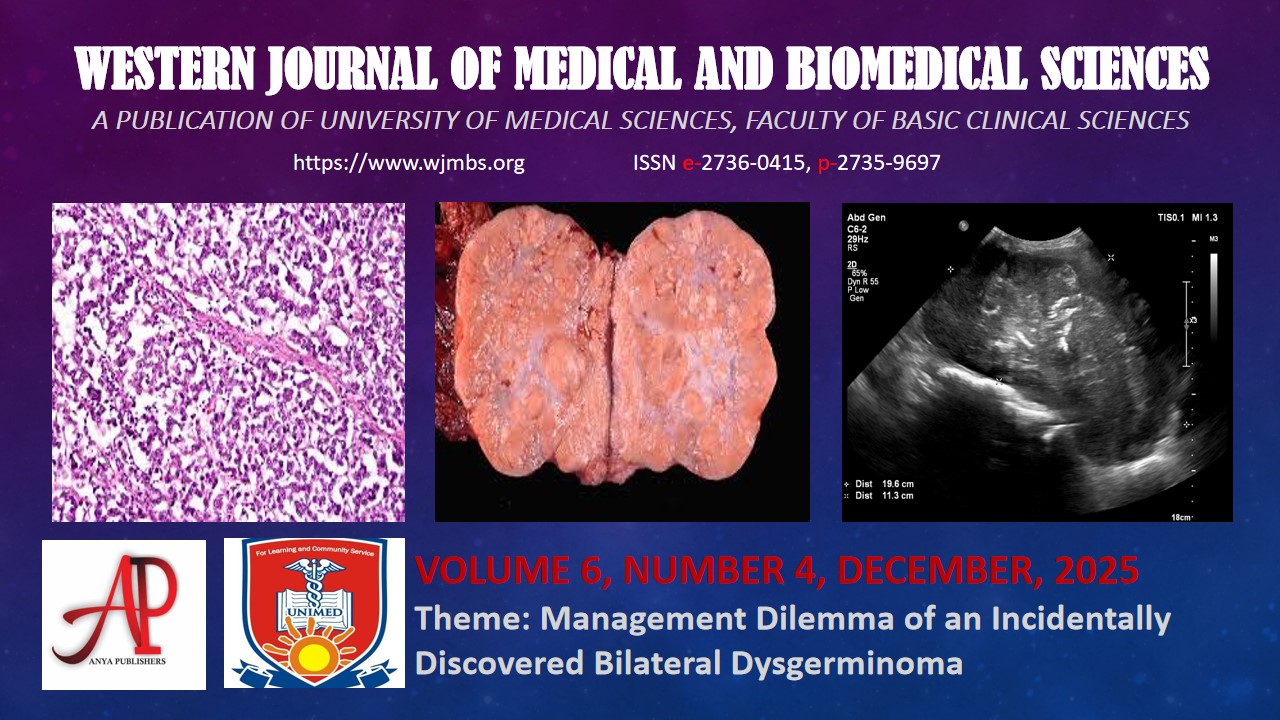
Management Dilemma of an Incidentally Discovered Bilateral Dysgerminoma in a Primigravida During a Caesarean Section: A Case Report
Keywords:
Chemotherapy, Dysgerminoma, Incidental Finding, Fertility Sparing Surgery, Oophorectomy, PrimigravidaAbstract
Dysgerminoma is a rare malignant ovarian germ cell tumor. It is mostly found among the women of reproductive age but not commonly associated with pregnancy. When it occurs in pregnancy, being a rapidly growing pelvic mass, it can cause fetal malpositioning and presentation, resulting in dysfunctional labour or obstruction. Also, the expected symptoms of dysgerminomas could be unnoticed in pregnancy due to the gravid uterus, only being discovered as an incidental finding causing challenges in its management. It was a case of booked primigravida who had an uneventful antenatal period presented in labour at a gestational age of 39 weeks. The labour was arrested at cervical dilatation of 6 cm with persistent fetal malpositioning. Subsequently, she had a caesarean delivery of a live fetus. Intra-operately, bilateral ovarian dysgerminomas were as found incidentally, however, she desired her future fertility to be preserved. She had unilateral oophorectomy and biopsy taken which was later confirmed to be dysgerminoma on histopathological examination. She was referred to gynaecological oncologist for chemotherapy and follow up. In conclusion, it is possible for dysgerminomas to develop de novo in pregnancy and rapidly grow to form a pelvic mass big enough to cause dysfunctional labour or mechanical obstruction at delivery. Fertility sparing surgery with chemotherapy could be an option in women desirous of future pregnancy if bilateral dysgerminomas are incidentally found at caesarean section.
References
1. Smith HO, Berwick M, Verschraegen CF. Incidence and survival rates for female malignant germ cell tumors. Obstet Gynecol. 2006 May107 (5)1075-86.
2. Zanotti KS, Belinson JL, Kennedy AW. Treatment of gynaecologic cancers in pregnancy. Semin Oncol. 2000;27: 686-698.
3. Gupta M, Saini V. Germ cell tumors and their association with pregnancy. Germ Cell. 2018; 31:123.
4. Chen Y, LuoY, Han C, Tian W, Yang W, Wang Y, et al. Ovarian dysgerminoma in pregnancy: a case report and literature review. Cancer iol Ther. 2018; 19(8):649-58. Htttps://doi.org/10.1080/15384047.2018.1450118.
5. Gupta M, Jindal R, Saini V. Bilateral dysgerminoma diagnosed during caesarean section. J of clin and diag research. 2016 Aug, Vol. 10(8):QD04-QD05.
6. Thannical A, Maddy B, DeWitt M, Cliby W, Dow M. Dysfunctional labour and hemoperitoneum secondary to an incidentally discovered dysgermonoma: a case report. BMC Pregnancy and Childbirth. 2021; 21:611.
7. Hashmi AA, Hussain ZF, Bhagwani AR Edhi MM, Faridi N, Hussain SD, et al. Clinico-pathological features of ovarian neoplasms with emphasis on borderline ovarian tumors: an institutional perspective. BMC Res Notes. 2016;9(1):205.
8. Boran N, Tulunay G, Caliskan E, Haberal A. Pregnancy outcomes and menstrual function after fertility sparing surgery for pure ovarian dysgerminomas. Arch Gynecol Obstet. 2005; 271(2):104-8.
9. Lazebnik N, Balog A, Bennett S, Redline R, Liu J. Ovarian dysgerminoma: a challenging clinical and sonographic diagnosis .
J Ultrasound Med. 2009; 28(10):1409-15:https://doi.org/10.7863/jum.2009.28.10.1409.
10. Goh W, Bohrer J, Zalud I. Management of adnexal mass in pregnancy. Curr Opin Obstet Gynecol. 2014; 26(2)49-53.
11. Pressley RH, Muntz HG, Falkenberry S, Rice LW. Serum lactate dehydrogenase as a tumor maker in dysgerminoma. Gynecol Oncol. 1992; 44(3):281-3.
12. Tewari K, Cappuccini F, Disaia PJ, Berman ML, Manetta A, Kohler MF. Malignant germ cell tumor of ovary. Obstet Gynecol. 2000; 95(1): 128-33.
13. Zamnanirs ex N, Rezaei PM, Ghasemian DS. Fertility sparing surgery in malignant ovarian germ cell tumor: 15 years experiences. BMC Women's Health. 2021; 282:https://doi.org/10.1186/s12905021-01437-8
14. Michener CM, Wu AY. Ovarian Dysgerminomas. Warner K Huh. 2015 available from:https://emedicine.medscape.com/article/253701
15. Solheim O, Gersherson DM, Trope CG, Rokkones E, Sun CC, Weedon-Fekjaer H, et al. Ptrognostic factors in malignant ovarian germ cell tumors. Eur J Cancer. 2014;50(11): 1942-50.